It’s been really hard to keep our mouths shut whenever you guys asked about our plans for consoles over the past few months. The truth is, we were always planning on bringing Lacuna to all major platforms eventually, but we didn’t want to make promises we couldn’t keep. Now the cat is finally out of the bag:
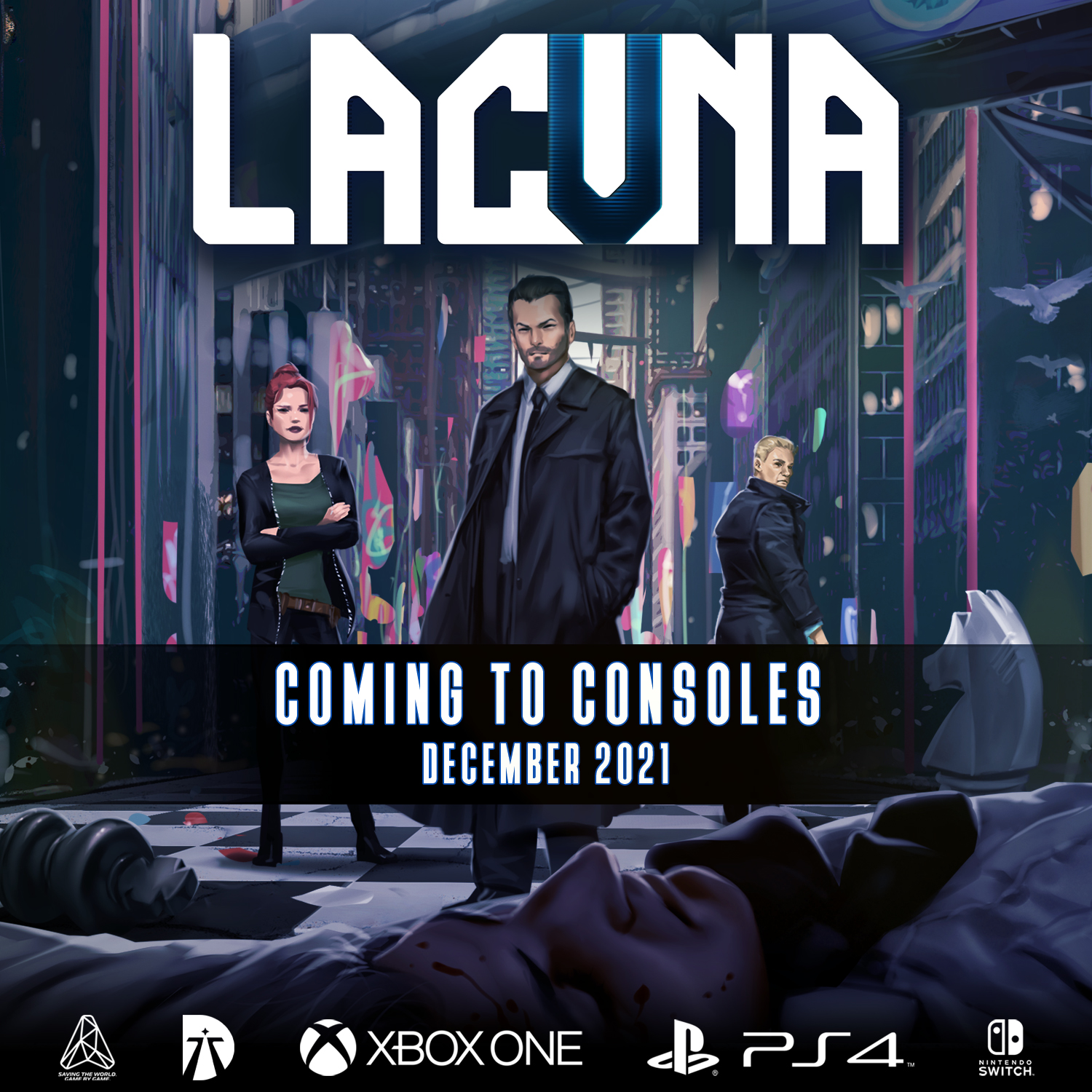
Lacuna is launching on PlayStation 4/5 as well as Xbox One and Xbox Series X/S on December 21st, and on Nintendo Switch on December 28th!
The game will be the same across all platforms, but if you’ve been holding out for its console release or want to give it another go, treat yourself this Christmas! There will be a 20% launch discount on Xbox and Nintendo Switch as well.
Please only refer to us as “award-winning” from now on.
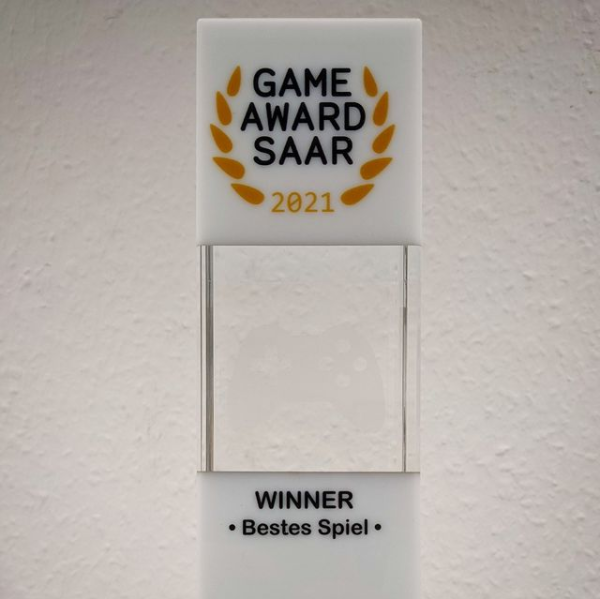
In other news, Lacuna won Best Game at Game Award Saar last week! It’s our state’s annual awards ceremony for locally crafted video games. Our prime minister Tobias Hans himself lauded Lacuna and bestowed it with the prestigious award and the €10.000 in prize money.
Lacuna is also nominated in two categories (Best Audio & Innovation Award) at Deutscher Entwicklerpreis, one of the biggest annual celebrations of video games made in Germany. Keep your fingers crossed for us and/or come see if we win live on stream next Thursday, December 9th!
We moved! Again! And then went back home.
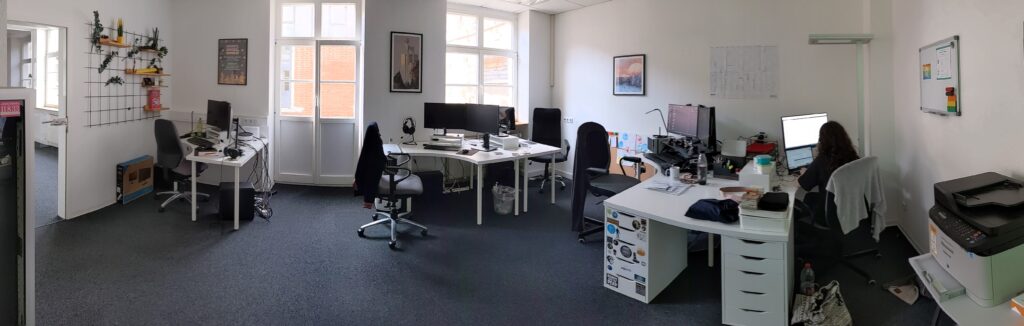
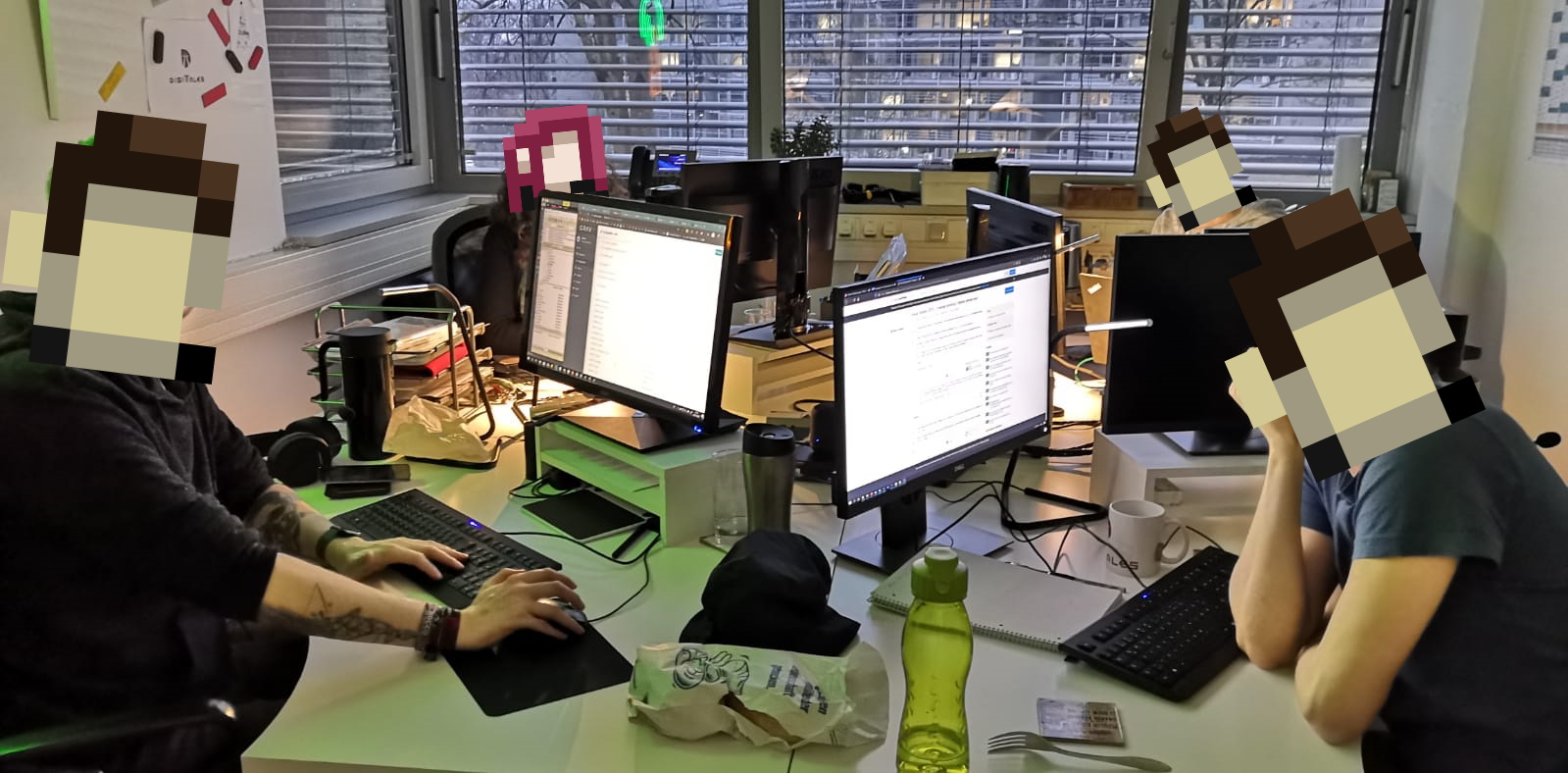
This September, we finally settled into our awesome new office in the center of Saarbrücken. We share the floor with a few fellow indie developers, and we couldn’t be happier about our decision to move to a bigger place, especially in light of our plans to hire two more people in early 2022. Unfortunately, just a few days ago, the fourth Covid wave forced us back into home office for the foreseeable future – but we will be back!
We could go on…
… and we will:
Nominate Lacuna for “Outstanding Story-Rich Game” on Steam!
Vote for Lacuna in the Indie of the Year competition on IndieDB!
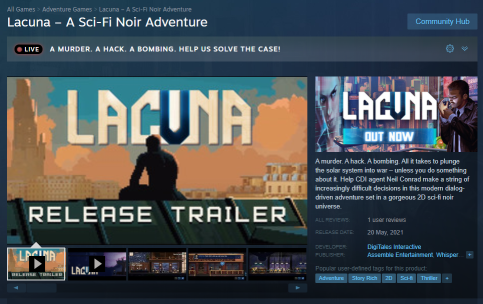
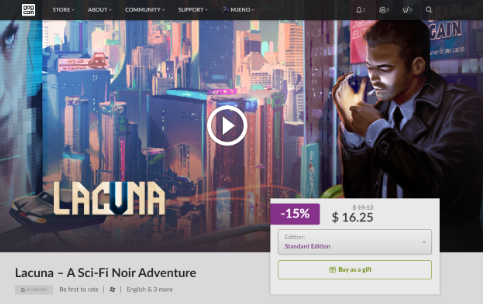
At long last, Lacuna is out now on Steam and GOG! We can hardly believe it ourselves. Thank you all so much for your support thus far, and for patiently awaiting the game’s release. Check it out:
If you want to support us, please consider recommending the game to your friends and leaving a positive review. If you’re on the fence about getting it, remember that there’s an hour-long free demo both on Steam and GOG.
You know us, we have a new trailer for every occasion, and the release is no different!
The game actually came out over two days ago, but there was so much going on since release that I didn’t have time to post the news sooner. It’s sitting at 96 Steam reviews already, 96% of which are positive. On its first day alone, the game sold a four-digit amount of copies and had over 5.000 viewers on Twitch. Needless to say, we are extremely happy about this very favorable reception.
We are also really, really exhausted. The weeks leading up to the release were very stressful, and we’re only slowly recovering. We’ll be around for a few more days to monitor the forums and release patches if needed, then we’re going on vacation for a bit. We’ll be back in mid to late June!
The title says it all, so I’ll keep this short and sweet!
Check out the new Lacuna: Prologue
It contains the same levels as the demo we released during the Steam Game Festival earlier this year, but there are two major differences:
It is much more polished, featuring new art, music, sound design, and mechanics.
It has a dedicated page, so you can leave a positive review if you liked it. This way!
Lacuna is coming out May 20, 2021
That’s right, screw “summer 2021”. We’re pulling what’s called a reverse Duke Nukem Forever and releasing the game earlier, less than a month from now! If you haven’t already, wishlist Lacuna here.
We hope you enjoy the Prologue and we can’t wait to share the rest of the game with you!
2020 has been an eventful year for many of us, for better or (mostly) for worse. Here at DigiTales, we were able to hire our first full-time employees in January, and we officially announced our debut title Lacuna in summer. We have been relatively quiet about it ever since – until now!
Almost content-complete
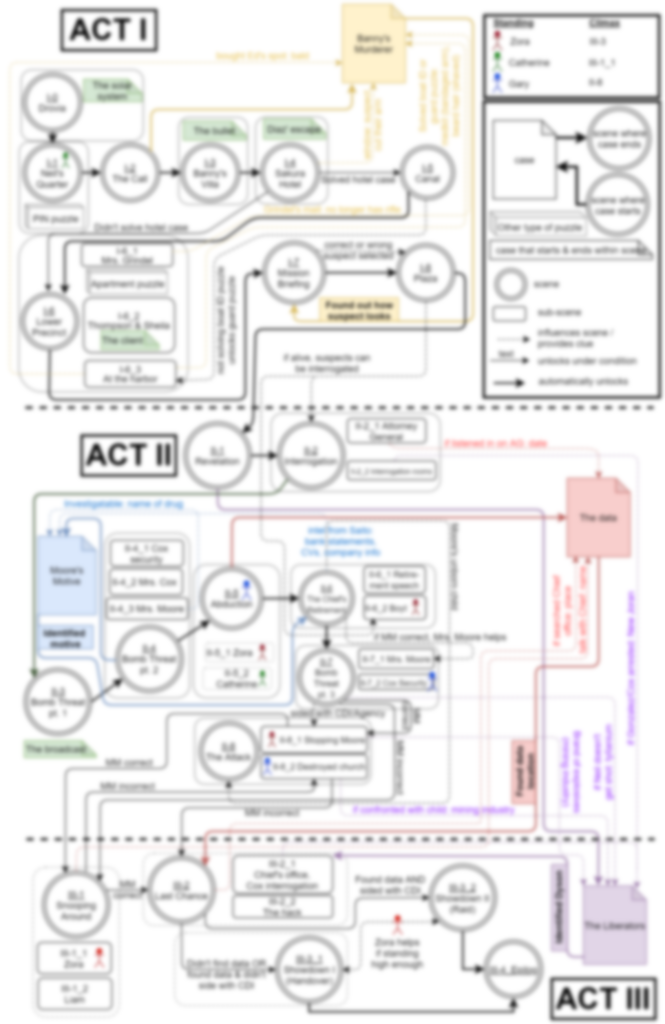
With Lacuna being a linear game that only has a handful of mechanics, a large part of our work has been the implementation of its complex story. The flowchart below provides a high-level overview over all the scenes, cases, central clues, and ways in which the player may influence the development and outcome of the story. I blurred it to avoid spoilers:
The very first version of the story existed all the way back in 2015, and the chart has evolved alongside it ever since, finally hitting version 1.0 the other day. Now all that’s left is some fine-tuning like tweaking the wording, refining the character arcs, and sneaking some more world building into the dialogs.
In terms of the story’s implementation, we have good news to share as well: It’s all in the game already except for the finale and epilog! We’re expecting to finish the story’s implementation up within the next three months, with a projected word count of about 60.000.
Demo early 2021
That’s right: Lacuna will get a free demo! It’s hitting Steam in early 2021 and will be available in English, German, Korean, Simplified Chinese and possibly more languages at launch. In fact, its translation is already in the works. If you don’t want to miss it, come back to our Steam store page some time in February.
Playtest sign-up
We’re running a big playtest over the holidays, which will include the first two of Lacuna’s three acts. If you want to help us out as a tester, please sign up here. Please make sure to only sign up if you’ll be able to commit a few hours between Christmas and early January. If you’ve registered before, you’re still on the list! Unfortunately, we cannot guarantee that everybody who signs up can be included.
Visual upgrades
In light of the upcoming demo, we’ve taken another hard look at Lacuna’s visuals and decided that they could be even shinier. More specifically, we decided to add character portraits, cutscenes, and a bunch more VFX.
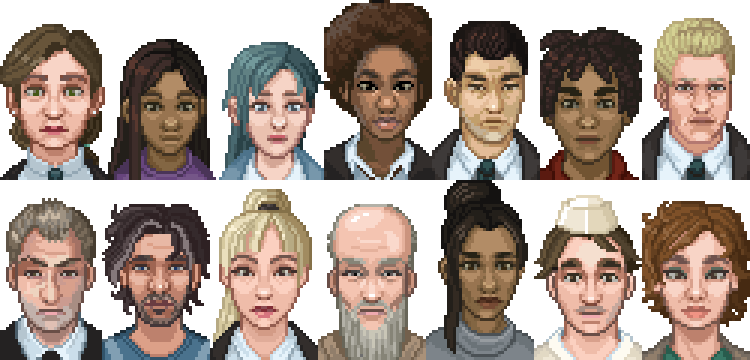
These are the portraits of most people you will encounter in the demo. Each of them has a set of facial expressions for their respective dialogs. The portraits are being created by the amazing Martina, who has been nice enough to make some time for us between her projects at Radical Fish Games.
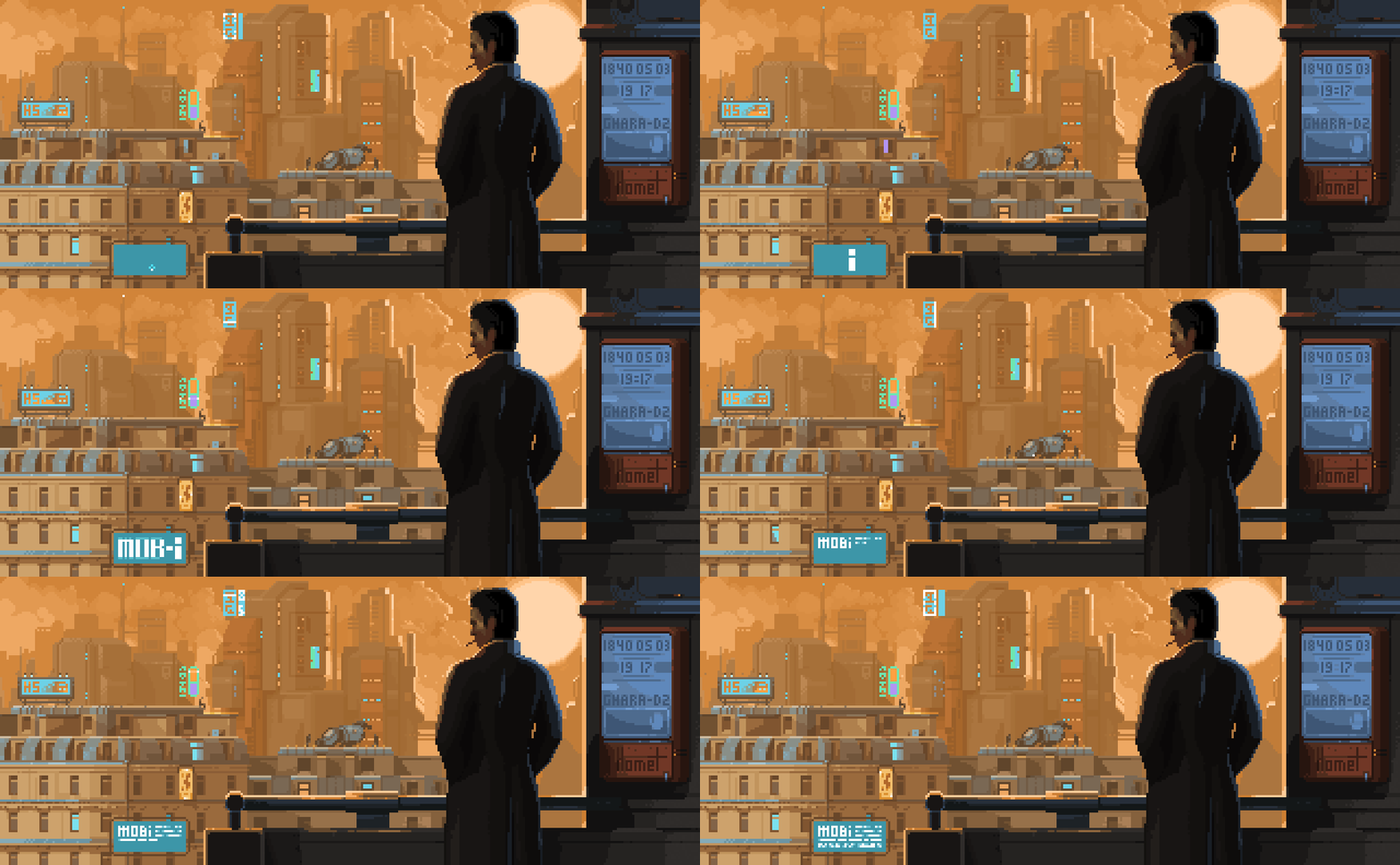
One thing we noticed while playing other adventure games for research was that occasional cutscenes go a long way in setting a mood, breaking up the pace, alleviating visual fatigue, and just increasing the perceived overall quality of a game. That’s why we asked the incredible Weilard to create six beautiful animated cutscene sprites for Lacuna. He finished the first one the other day:
But that’s not all. Additional particle, shader, and other visual effects created by our fantastic shader magician Simon over the past few months have elevated Lacuna from a pretty pixel art game to a veritable visual feast, if we may say so ourselves. Leaves blown by the wind, fog billowing on the water, fire, smoke, rain, leaves, reflections, and more really bring its atmosphere to life.
Next project
Even though we will be working on Lacuna for a few more months, we already need to think about what we’ll do next in order to avoid too much downtime between the projects. That’s why we’ve already cooked up a new concept we’re going to turn into a prototype next year. To that end, we recently received €20.000 in funding by Game Base Saar (a local funding program)! Here’s a tiny sneak peek, we don’t want to give away too much:
I almost feel bad for writing this, but 2020 has actually been a good year for us overall. The death, despair and political turmoil around the world have of course affected us and the social isolation is getting us down, but we’re also aware of and grateful for the privileged positions we’re in. We were able to switch to home office indefinitely without fear of exposing ourselves to the virus every day or losing our source of income. We worked on our game full time, which is a dream come true, and mostly managed to stick to our deadlines, a rare occurence in game development and much more so for a debut project. I’m really proud of what we’ve achieved this year despite everything that 2020 has been throwing at us, and I can’t wait to see what we can do once things are back to normal.
Anyway, make sure to sign up for the playtest if you want, and keep an eye out for Lacuna’s demo in early 2020. Also, subscribe to our newsletter to get future updates like this delivered to your inbox! We use it very sparingly, promise.
We wish you an adequate holiday season given the circumstances. Things are about to look up, I’m sure of it. Stay safe, merry Christmas, happy New Year, see you in 2021!
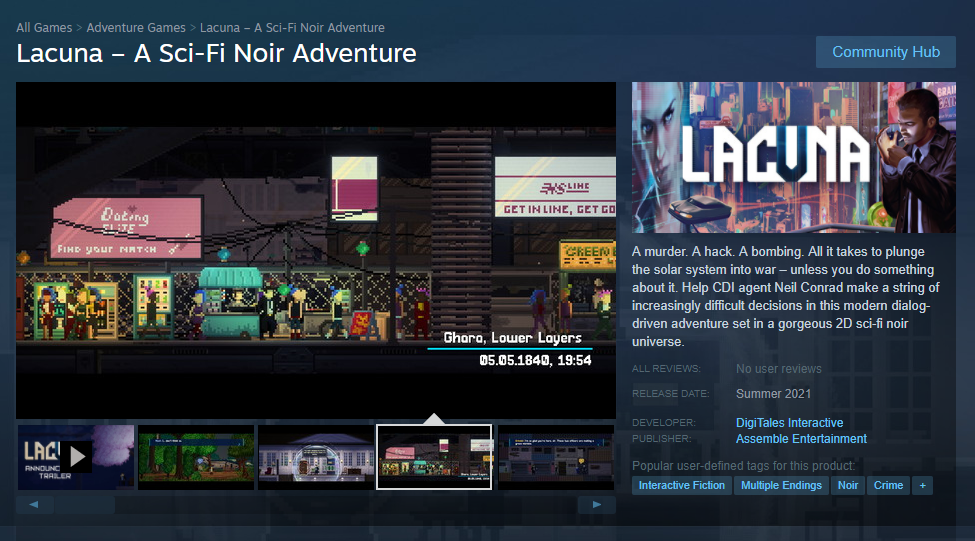
We just announced our first title: Lacuna – A Sci-Fi Noir Adventure. Its Steam page is now live, which feels a little surreal. The game will be published by Assemble Entertainment, a fantastic German publisher who believed in the project from its very start.
Much more on the game is to come in the following months. We’ll show some gameplay soon and go in depth about different aspects of it in a series of devlogs. Right now, go check out the new trailer, artwork and screenshots, and most importantly: wishlist and follow the game on Steam. This way!
We want to take this opportunity and say thank you from the bottom of our hearts to everybody who has been part of Lacuna’s journey so far.
Compared to film and literature, games are still a fairly young medium. As we could see with films, it always takes some experimenting until new art forms find their very own means of expression. In games, this process is further complicated by the fact that, over the past few decades, technological innovations in hardware and software constantly renewed and changed the possibilities of game design.
Since their inception, games have been looking for ways of telling thrilling, deep stories that can keep up with films, series or novels in terms of quality and that nevertheless make use of the most important medial specificity of games: their interactivity. Unfortunately, this great potential can also be a huge problem when it comes to writing interesting stories.
In this blog article, I will outline some of the most important challenges and difficulties we have encountered so far when writing the story for our upcoming narrative game. I will get into some of the solutions we found in my upcoming posts, but I hope that today’s article will be helpful as well – it might point you to some aspects you could take a closer look at if you have the impression that your game’s story isn’t as exciting as it should be.
Challenge 1: Dramaturgy
One big challenge consists in designing a tight dramaturgy for your game. You want your audience to be glued to the screen, much like when they’re binge-watching a show. To keep the narrative pace up, films and novels usually work with loads of ellipses, meaning that they only show you the most interesting parts of the story and skip the rest.
In the first Lord of the Rings movie for example, you don’t see the fellowship of the ring walk from Rivendell to Lothlórien for hours. Instead, you only get the scenes that are action-packed, relevant for character building, or otherwise important for the progression of the plot.
Skipping less interesting parts isn’t as easy in games since the player often is in control of the protagonist. For example, let’s say our hero is in her apartment and finally decides to break up with her girlfriend. In a film, the next thing we would see is the protagonist standing at her partner’s porch. In a game, we have control over the hero, which at the very least means we need to make them walk over to their destination ourselves.
To make such mundane things interesting, games often add challenges such as search for the coat, key and phone of our hero, and then navigating her through the city and finding a way across those building sites that block the road she usually takes. Unfortunately, this often tends to draw things out even more.
Although it is important to give the player agency and different possibilities to go about something, interactive passages in narrative games can easily cause a drop in tension and give the audience a good opportunity to zone out. Telltale Games titles like The Wolf Among Us illustrate my point: They have a very tight dramaturgy and, in my opinion, are highly successful in creating tension. On the flipside, they have to reduce interactivity to a minimum in order to do so.
Challenge 2: Character building
In films, series and novels, the writers often put a lot of work into creatinginteresting, believable, and ambiguous characters. Public discussions around successful shows like Game of Thrones (up to a certain point) and Breaking Bad have demonstrated that audiences value these efforts. In games, we again face special challenges when it comes to character building.
As mentioned above, the player is often in control of the protagonist. However, at the beginning of a game, you don’t know anything about your avatar, meaning that there is a big discrepancy in knowledge between you and the character you are supposed to identify with. Nevertheless, you often have some influence over the protagonist’s behavior and, in many games, may even have to make decisions for them. This can make you very aware of the divide between you and the protagonist and thus hinder identification and immersion.
If you’re making a game that allows players to influence the course of the story, it can be very hard to create consistent, believable protagonists. Let’s say the player can decide how the protagonist behaves in certain situations. If the options between which the player can choose are very different from each other (e.g. they can either knock out a suspect or take a friendly approach), the choice is interesting and meaningful, but unless your protagonist suffers from multiple personality disorder, it’s hard to justify why both options represent plausible behavior.
On the other hand, if the choices are basically one and the same (e.g. take a friendly approach or a very friendly approach), they are more consistent with your character’s personality, but they aren’t interesting for the player and won’t give them the impression that they really have an impact on the story.
One more difficulty consists in finding appropriate ways to display your character’s personality. In novels, inner monologues and insights into the protagonist’s head allow the readers to learn how they think and feel. In visual media like films, authors mostly stick with the paradigm of “show, don’t tell”, meaning that they don’t tell us what the characters are like, but let them show their personality through their behavior.
Games also belong to visual media, but depending on the art style, the range of what you can show is extremely limited. In films and series, the of the actors’ performances may draw a very nuanced picture of the characters. They are able to make use of body language, intonation, facial expressions, and gestures. In a game, you might not have the budget to use voice acting, and if you go with a low-res or abstract art style, integrating detailed facial expressions isn’t an option either.
To sum it up, creating complex, nuanced, and consistent characters can be difficult due to the player’s influence and the limited means of expression.
Challenge 3: Gameplay
The third challenge concerns the potential interferences between gameplay and narrative. When you’re writing a story, you usually want to your audience to be completely immersed into the plot and, to a certain degree, forget about themselves and the real world they’re in. However, in an interactive medium, this absorption into fictional story worlds can be hard to achieve.
This might sound counter-intuitive, but as soon as you have to actively do something and start to act, you necessarily become aware of yourself again. Of course it’s possible to completely immerse the player into the story world during interactive passages, but it is harder to achieve than in non-interactvie media. Please note that I’m only talking about immersion into the story. Immersion into the gameplay can of course be increased by interaction, but it often takes the focus away from the story.
There’s a number of difficulties related to gameplay and interactivity. I will go into them in more detail in my upcoming posts, but I will highlight some that seem particularly important to me.
First, in many games, it is possible for the player to fail: They can die in a fight, fall off a cliff or, as is the case in some older story-driven games, pick the wrong choice and thus cause the game to end. If you fail, you can usually retry from a nearby save point. However, the ability to try again makes failure narratively meaningless. You just do the part over and over again until you succeed; there aren’t any consequences whatsoever for the course of the story.
As a consequence, when you have to pick your next choice for example, you’ll just try any one you haven’t tried before to see what brings you success, and it won’t be a tough decision for you. In addition, every time you see the “Game Over” screen, you’re reminded of the fact that you’re playing a game. In short, failure that temporarily ends the game often breaks immersion.
Second, being stuck at a certain point can also have an extremely negative impact on your immersion. You might get annoyed because you can’t solve the puzzle. You might start doing random stuff hoping to find another clue. You might even tab out of the game and Google the solution. Whatever you do, you certainly don’t feel like you’re the protagonist facing a life-threatening situation anymore.
Third, it can sometimes be hard to find a good balance between complexity and accessibility. Complex stories are often more interesting, realistic and subtle than those that follow a simpler formula. However, depending on your mechanics and your game design, it might be vital that the player have an idea of what is happening. In a detective game, they might even have to be able to reconstruct the course of events or to uncover hidden connections.
This, in turn, can be difficult to achieve if you have a multi-layered story. If, for example, the player controls a detective and has to find out what happened at a crime scene, you have to make sure that there is only one plausible version of events. In reality, things usually are rarely that clear-cut, and the story is usually more authentic and credible if you try to mimic the complexity of real life to a certain degree.
All in all, those are some of the most important challenges we have faced and still face working on our story-driven game. As promised, I will talk about some of the solutions we came up with in my upcoming posts. If you encountered different problems while working on your game’s story, tell me about them. And if you found my article useful, feel free to share!
Welcome to our new blog. It will feature news, development updates, game dev tips, and the occasional unrelated opinion piece. Without further ado, let’s get to the first ever news entry!
So what’s up?
Here’s what’s going on besides our website overhaul: Part of our team is still working from home due to the pandemic, but it’s going smoothly so far and we haven’t missed a deadline yet. As for what we are currently working on, we’ll tell you that towards the end of the year. We have a great project in the works with a great partner, and we hope you’ll be impressed with it. In the meantime, you can enjoy some upcoming blog posts about certain mechanics, learnings etc. that won’t give too much away about the game itself. The first one coming up is a breakdown of smooth controls for movement on stairs in a 2D sidescroller.
Become a tester
If you can’t wait and want a chance at a sneak peek of our game, we are currently accepting some new testers for an ongoing playtest. Sign up here, and you may be contacted once the next round of tests is sent out. Sorry about the legalese; we’re just trying to cover our bases.
Stay safe
That’s the news for now. You’ve probably heard the phrase “in these uncertain/crazy/trying times” a lot lately. That’s because signing off with just a “See ya” currently feels out of place. People everywhere are battling a pandemic, systemic injustice, and more. We sincerely hope that, rather sooner than later, we’ll come out on the other side of this looking at massive improvements in all those areas. Until then: hang in there, stay safe, stay strong.