If you’re reading this, you’re already looking at our brand new website. It’s now WordPress-based because (for better or for worse) it’s a widespread standard that we also happen to be most familiar with.
New DigiTales logo
I’ve been meaning to migrate the site for years, so what drove me to finally do it? Well, I tried and failed to update the company logo on our old site for the better part of an hour.
Check out the new logo below; we’ve streamlined both logotype and logomark, ditched the magenta color, and added an animation and a jingle:
Since we’re about to be a publisher, we also made this – to be used in at least one future splash screen:
New team member
In other news, we’re excited to announce that we recently welcomed a new member to the team: Say hi to Alex, who is lending his programming skills to our growing roster of ongoing projects. This brings DigiTales back to four in-house team members, which feels exactly right for us.
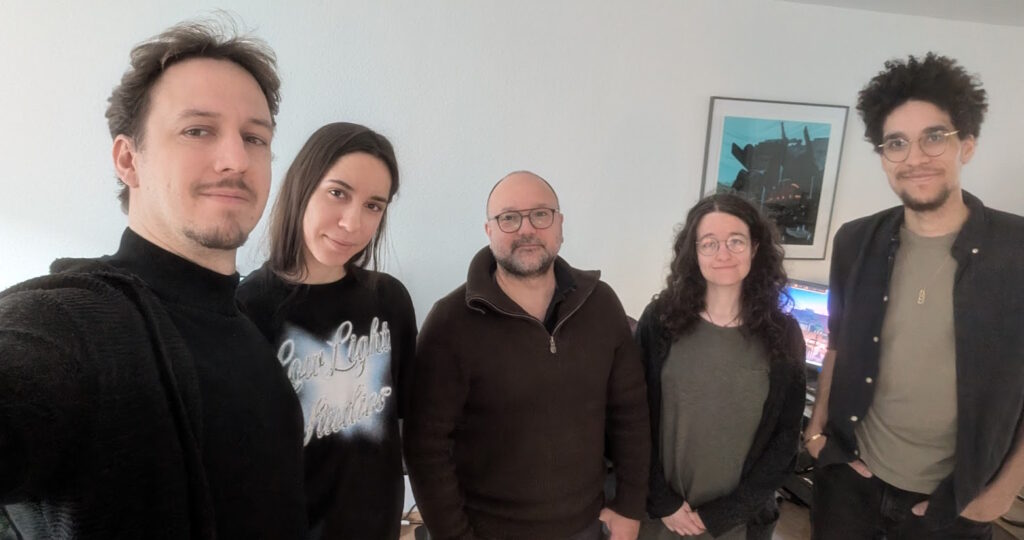
Apologies for the lack of a proper team photo. All pictures we have of the four of us together are sloppy selfies at bars and restaurants. At least we seem to be living the high life. 🍸
New project funded
Unless you follow our local news, you probably missed that late last year, we won an award for a project codenamed Courtyard. More specifically, we won the Best Concept category at Game Award Saar, which was endowed with €15,000.
That’s me holding the award on the left.
A few months later, we went on to receive a grant financing its pre-production. We didn’t want to keep this particular bit of good news from you, although the official announcement of Courtyard is still a few months out.
For now, all I can say is that Courtyard is a smaller side project and not usually what you’d expect from us. It’s been very refreshing to work on something completely different after a decade of only detective adventures, and to make quick progress due to the smaller scope.
That being said, Courtyard is notgetting in the way of The Great Sassanelli or From Ruins, both of which remain on track for their respective releases. On that note…
From Ruins @ gamescom 2026
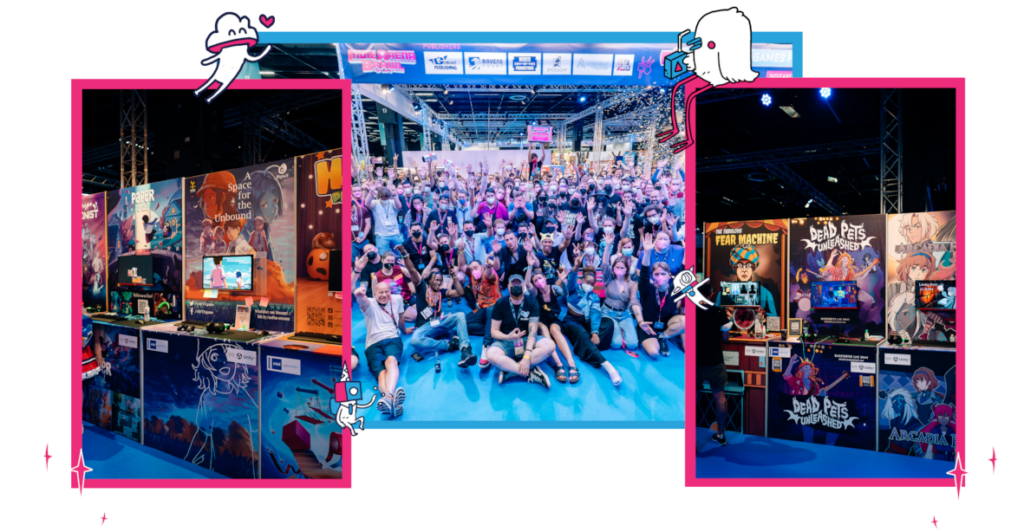
After its very warm reception at DoKomi in May, we’re bringing the From Ruins demo to gamescom next! You’ll find us in hall 10.2, nearby the Indie Arena Booth (not inside it). We’re sharing a corner with some fellow Saar Indies at the GameUp! Rheinland-Pfalz booth (D043g), a collaboration between our state of Saarland and the neighboring Rhineland-Palatinate.
Besides From Ruins, our booth will feature demos for games such as Mindlock and Alabaster Dawn. Just keep your eyes peeled for this artwork:
We’re actually taking part in two more events next month, and already have another two lined up for Q3, but we can’t speak on those just yet. Follow our socials so you don’t miss those announcements!
Other than that, we’ll keep grinding away at our projects. I’ll write another blog post this fall – once The Great Sassanelli releases or Courtyard is officially announced, whichever happens first.
Since the Sassanelli demo release just a few weeks ago, we’ve taken part in numerous digital showcases, exhibited the first public From Ruins demo at DoKomi, and revealed two new trailers!
Mechanics trailer
Last week, we released a new trailer as part of Thinky Direct, which kicked off the week-long Cerebral Puzzle Showcase. We’re very grateful that our game was selected to be included, and we recommend you all go check out their stellar selection of puzzle games. If you missed Thinky Direct, you can view the new trailer on our YouTube channel below (and subscribe 💖).
Behind the scenes video
Just a few moments ago, we also revealed our exclusive trailer for the Women-Led Games 2026 Summer Showcase. It spotlights both the fictitious women in the game – giving a first insight into the story –, and the real women developing it – providing a peek into our work behind the scenes.
DoKomi 2026
Last weekend, we exhibited both From Ruins and The Great Sassanelli at DoKomi’s Creative Games Area. This was the first time we showed From Ruins publicy, and the reception was very positive, which was incredibly encouraging. Thanks again to everyone who stopped by, played our games, and/or had some nice words or constructive criticism to share.
Sassanelli @ Steam Next Fest
While the From Ruins demo will come to Steam eventually, you can already play our demo of The Great Sassanelli on Steam right now! It will also be part of the upcoming Steam Next Fest, so if you play it between June 15 and 22nd, it’ll give us an extra boost in the algorithm. We’d really appreciate it!
Thank you all for reading, watching, liking our stuff – and until next time!
It is with great pleasure that we announce today’s release of the Great Sassanelli Steam demo! It contains the first few days of the story, introducing you to its wondrous world and cast. It also teaches you the core mechanics of the game, although much more will be waiting for you in the full release.
Since some of you might be wondering: 🖥️ Yes, the demo is available on Windows and MacOS! 💾 Yes, your save file will transfer to the full game once it comes out! 🎮 Yes, gamepad and Steam Deck are fully supported!
We’ve spend the past few months testing and polishing the game, and we really hope you enjoy today’s sneak peek. If you still encounter any issues or bugs, please don’t hesitate to report them on the community forum, the DigiTales Discord server, or via email to support[at]digitales.games.
We also have a new trailer for you today. Since the cinematic trailer was more focussed on the premise and aesthetics, we thought it was high time we added a more descriptive one to complement it. Check it out now to get an overview of the game in just over two minutes:
This is Julian from DigiTales. Today, we are thrilled to reveal our third game From Ruins, a narrative detective adventure set in a post-apocalyptic world. Check out the Steam page below for all the details, including the short but sweet reveal trailer. If you do only one thing with all this information, please wishlist the game! This is currently the number one way to support us and its development:https://store.steampowered.com/widget/4024450/
That being said, stick around if you’d like to know a little more about the future of the project and our studio.
Same same but different
The concept for From Ruins as well as early prototypes have existed for almost three years at this point. With 2025 drawing to a close, and a year after the console release of our second game Between Horizons, we are already deep in its production phase. The game is virtually feature-complete and free of bugs, with a large part of the campaign already finished. We’ve been testing and reiterating a lot (much more extensively than we did with our past games), and the feedback has been very positive. All that being said, don’t expect the game to come out before 2027 for a number of reasons.
If you enjoyed Lacuna and/or Between Horizons, From Ruins should be right up your alley. However, there are a few notable deviations to the formula, which were mostly inspired by the Golden Idol series. Case sheets, although a core mechanic of our previous titles, are now more elaborate than ever before. You’re tasked with filling in the nouns and verbs to form sentences that best answer the question posed by the case at hand. And besides the clues you uncover around the levels and by questioning suspects and witnesses, you now also collect the very words you need to fill in the gaps in the case sheet.
There is another aspect to From Ruins, albeit a small one, that was completely absent from our previous titles: mini games. We’ve found that, at the very least, these short brain teasers provide a nice break of pace and small dopamine hit half-way through a larger case. We’ve made sure that, even though they are somewhat self-contained, solving mini games always advances your investigation in one way or another, e.g. by unlocking the path to a new person to talk to.
Other than that, From Ruins is all you’ve come to know and hopefully love from our titles: deduction gameplay embedded in a story full of twists and turns, as well as some tough choices along the way that influence the way the game unfolds and ends. Regarding the art style, you may have noticed that we went back to 2D after venturing into 2.5D with Between Horizons. To put it bluntly, we’ve come to the realization that we can create a denser, prettier world in a similar, if not smaller time frame by ditching the third dimension. It didn’t add much, and we haven’t missed it over the past year.
Self-publishing
Even though From Ruins is somewhat similar to our previous titles, it’s a major, scary step for us from a business perspective. As you may know, our previous releases were published and partially funded by German publisher Assemble Entertainment as well as additional partners for the Asian markets. This time around, we are flying completely solo, which means that all the marketing, PR, and distribution work falls on us. Like for many studios who have taken the same plunge, this might end up being a do-or-die situation. If you care about us and/or our ability to keep making games, it’s more important now than ever before to help us get the word out. Besides putting From Ruins on your wishlist and telling your friends about it, following and engaging with our social channels would go a long way!
On the plus side, not having a publisher on board enables us to talk about our new game however and whenever we want. We’ve never believed that secrecy will help “build the hype”, so we’d like to share the development of our games much more openly going forward. Please come and join our Discord community, or say hi on Twitch, where I’ll start streaming development of From Ruins very soon. If you’re reading this around the game’s reveal, then there should already be a scheduled stream coming up!
You may have noticed that, at least for now, we only list English and German language support on Steam. We also don’t have any plans at this time to support any operating systems other than Windows, bring the game to more store fronts, or port it to consoles. This is all because we are a smaller team than ever before, with no external funding whatsoever, and all the marketing and publishing responsibilities on our shoulders. We need to play things slower and safer than we did with our previous titles, when external funding and publishing allowed us to launch with more languages and on more store fronts at once. That being said, we hope and aim to include additional languages, stores, and platforms as time goes on and interest in the game grows – be it before or after its eventual Steam release.
The detective trilogy
Even though the release of From Ruins is still a ways away, I can already tell you that our next game won’t be another detective adventure. In 2022, we revealed the Kickstarter page for our next big project: a psychological survival horror game named Unburied. At this stage, it’s still not much more than a concept, albeit a quite detailed one that we’ve done a ton of research for over the years. On a technical basis, the project will hugely benefit from what we’ve been building in the past and are presently building for From Ruins. That being said, we might take one last, relatively short detour next year before tackling another massive, years-long project. I’ll tell you more if and when that happens!
Speaking of branching out, we also have the release of The Great Sassanelli coming up next year! Developed by our friends at Forking Paths Gardening, it will be our debut as a publisher. We’ll start showing it off much more on our socials next month, so be sure to follow along. Finally, we currently have a winter sale going on over at the 6VCR Shop. Check it out if you’re in the market for pixel art stickers, digital wallpapers, or the newly released limited-edition signed prints.
Anyway, that’s more than enough plugging of our stuff for one post. We can’t wait to share the conclusive title of the DigiTales detective trilogy with you. We believe it’s on track to becoming its best entry, but you be the judge when the time comes.
As always, thank you so much for all your support. Happy holidays, everyone, and have a nice rest of the year! 🎆
Hi! This is Julian, CEO of German indie game studio DigiTales Interactive. We’ve created two sci-fi detective adventures for PC and consoles: Lacuna (2021) and Between Horizons (2024). In this post, I’m reflecting on the development, release and reception of the latter, while touching on a host of larger topics surrounding game development and this industry I’ve been a part of for over a decade now.
It is a lengthy read, and it took me two full days to write. It’s an honest attempt to pass on all my learnings from about four years of production, and to caution you about all the mistakes I’ve graciously made so you don’t have to.
I hope you’ll find it useful or at least interesting. If you have your own thoughts on the matter, be it objections, questions, additions, or corrections, please don’t hesitate to reach out to me and/or share them wherever you are reading this. Without further ado, here it comes. I’ve dug up many outdated meme templates to help you get through it!
Part 1: Suffering from success
I’ve often heard people say that the beginning is the most difficult part. When you have no idea what you’re doing yet, and the task ahead is a vast, uncharted mountain range that disappears into the clouds – that’s what your first big game project feels like. The majority of people don’t see it through, and even most of those who do never make a second game. This comes as no surprise as statistically, your game will crash and burn commercially.
Now, picture this: Your very first game gets signed by a publisher. You manage to secure a 6-figure amount in funding. You finish production in time, and it’s a success beyond any reasonable expectation. You go on to sell 300.000+ copies across platforms, win awards, and receive accolades from players and journalists across the globe. You’ve made it, right? Things only get better from here, right?
This happened to us with Lacuna. Then came our second game Between Horizons. All told, its production was far from a disaster compared to many industry horror stories. We did manage to finish it without severe burnout, and it turned out pretty good. However, despite having learned so much from our first game, we ended up finding a plethora of new mistakes to make. To an extent, I now believe that being in a comfortable position for a while, having secured funding for a few years worth of development, made us a little complacent. Not in the sense that we were ever lazy, but that we took too much time for irrelevant things while our budget was slowly melting away. To expand on the mountain climbing metaphor, we were obsessed with security on our first ascent, only to forget clipping in our carabiners on the second.
Ultimately, Between Horizons took more time and money to make than I had estimated, and I’m about to lay out extensively why I think that was – but even if it hadn’t, its commercial prospects were never looking great. Public reception was lukewarm from the beginning. Even though our publisher submitted the game to many festivals, awards, store events etc., it wasn’t wooing people the way we had hoped. This trend continued after it came out: The game did launch with more Steam wishlists than Lacuna had due to a longer pre-release period, but conversions were slow to come in. It doesn’t take an expert to deduce, just based on publicly available data, that Between Horizons likely hasn’t made its money back yet. As of September 2025, it sits at just over 400 Steam reviews, which does not measure up to the (relatively modest) production budget of a game this size.
That being said, if it had been our first release, I would feel differently about it. Tens of thousands of people have played Between Horizons, and 91% of Steam reviews are positive – that’s still something to be proud of, and it puts the game above the vast majority of releases on the platform. However, a year and a half after its release, it is lagging behind Lacuna by a wide margin. Why is that? Are we just a one-hit wonder? Did we peak at our first release, doomed to forever chase that high?
Fortunately, I don’t think that’s the case. Let’s dive into the much more complicated truth.
Part 2: Growth for growth’s sake
Some of the takeaways in parts 2 and especially 3 are very subjective and will only apply to certain situations and personalities. If you’re an allrounder like myself working alone or in a small team, I might be able to caution you about some potentially costly mistakes. If you aren’t, there are still many general considerations in there for you, such as finding the right game to make next.
Play it safe
Success is when the numbers go up, right? If your first game made its money back and then some, capitalist logic dictates that it’s time to expand. The next one will be more ambitious in every way, requiring a bigger team and budget. With the bigger investment comes a bigger game, comes a bigger audience, comes a bigger return on investment. Money printer go brrrr!
Not at all. Do not fall for this trap.
Don’t fix it if it ain’t broken. Do not grow the team, do not expand the scope of your project, do not increase the budget, unless you have a banger of an idea that absolutely requires you to. If your first game was successful, your learning should be “keep going”, and not “change it up”. Even though we somewhat stayed the course by making another narrative sci-fi detective game, and the changes to the formula were well thought-out based on decent game design ideas, the required expansion of the budget killed any chance of breaking even in an acceptable timeframe. Know your niche, and be realistic about the return of investment you can expect.
Success comes in many different forms. If you run a 3- or 4-person studio that can comfortably exist for decades without a major hit, I would call that an incredible feat. It would make me very happy, and in hindsight I don’t know why I didn’t aim for that in the first place. In my mind, success meant we had to grow, which it simply does not.
Don’t play it too safe
All that being said, I have another piece of advice. Do not make a sequel either. This is admittedly not something we learned first-hand, as we decided against it early-on. I want to explain the reasoning behind this, since you might have been yelling “IF YOUR FIRST GAME WAS SO COOL, WHY DIDN’T YOU MORONS MAKE A SEQUEL THEN” at the screen for a while now.
At least looking at anecdotal evidence, the sequels created by our fellow indies always seem to perform worse, often far worse, than the first game of the series. I doubt that this is because sequels are consistently just worse games. Imagine this: You’re browsing Steam and see that Awesome Game 2: Return Of The Awesome just released. It’s 10% off for the first week, but the first Awesome Game is 75% off in the same period for a nice little synergy effect. You click that one because you haven’t played it either yet, and maybe it makes more sense to start the series in the beginning. Perhaps you decide to buy Awesome Game 1, or perhaps you realize that it’s been sitting in your library for two years already, completely untouched. You put Awesome Game 2 on your wishlist and decide to wait for it to be more steeply discounted. After all, you haven’t even gotten around to Awesome Game 1 yet. A year later, you get a notification that Awesome Game 2 is now 50% off. You still haven’t touched Awesome Game 1, or maybe you have, but you never finished it even though you liked it alright. As soon as you finish it, you will surely buy Awesome Game 2… (None of that will happen.)
That’s just a story, but maybe it sounds relatable to my fellow adult gamers out there. If someone has data specifically on sequels that backs up or refutes my thinking here, please hit me up! I’m happy to amend this paragraph.
Here’s how to play it, maybe
Looking back, I believe we should have stuck closer to Lacuna with our second title. After all, we had only just gotten the hang of it. Changing the art style (adding a 3rd dimension no less), and making the gameplay formula much more open-world were unnecessarily drastic changes that threw us into deep ends we didn’t even need to be in. Iterating more slowly and maybe even narrowing the scope, really getting to the core of what makes the detective genre fun, would likely have been the better approach. (I can neither confirm nor deny that this is what we’re doing with our third game.)
That being said, many studios completely change up the genre from one game to another. There can be good reasons for this, but they need to be reality-checked. The same goes for upping the scope and budget, which I cautioned earlier to only do if your banger idea justifies it. I urge you to test your new idea in every way possible, as early as possible, before you start throwing money at it. Do not start by hiring new people to realize the idea; develop an MVP with your tiny team and show it to your intended audience. There is no other way to find out if it is indeed a banger and worth expanding or switching genres for.
In fact, I’ll go one step further: The new meta might just be to throw a lot of concepts at the wall – the wall being Steam – and see what sticks. Put together a concept for a small game with a clear focus, set up a store page, and create some buzz with as little time investment as possible to gauge interest. Set up kill gates (obtain x wishlists in y months) and consistently scrap projects that don’t make it across. If something has legs, make an actual game off the bullshots. I’m personally (at this point in time) too idealistic and too passionate about certain ideas, but this seems like a commercially sound strategy compared to what most of us indies do – flying blind for years in the hopes that someone will care once we get there. Maybe if more of us tested ideas early this way, the majority of indie games wouldn’t be years-long sunken cost fallacies.
Part 3: Focus on your strengths
I’ve made it clear that wasting money on tasks, services, features, and ultimately time that we did not actually need was a major mistake on my part. However, there is another hidden cost to it, which might be the most detrimental to both the project’s final quality and the pace of its production: While I was a major creative force on Lacuna from beginning to end, directly working on literally all aspects of the game, I spent more than half my time on Between Horizons with management. This is not to say management is terrible or unnecessary, but it has two severe downsides.
Don’t hand off your baby
First, I effectively left much more of the creative work to others. Although many people made fantastic contributions to Lacuna, it was in large part my brainchild, and people liked the creative work that I had personally put into it. My co-founder and I wrote the entire story and in-game texts, co-designed all of the cases, put together all the levels, and implemented the entire story logic. On top of that, I composed the entire soundtrack safe for two guest tracks. With Between Horizons meanwhile, I handed off much more of the creative work to others.
It may be obvious to most readers, but it bears repeating that productivity does not scale linearly with the amount of people. If one person can make a game in a year, then twelve people can make that same game in a month, right? Every employee adds an overhead of communication and bureaucracy. Think hard before putting all the time and energy of (presumably) your most productive worker – yourself – into maintaining this structure, especially when you have already proven to do good work in other areas that would receive less of your attention.
My decision to voluntarily maneuver myself into more of a management role is another one I do not understand in hindsight, and not just from an efficiency standpoint. Spreadsheets, sprints, and effort points aren’t not fun, but they’re certainly not why I got into game development – the creative part is.
Don’t surrender control
Second, I lost all control over certain aspects such as the code base and the 3D art workflow, neither of which I had the time to learn much about. This didn’t just make me feel uneasy, it had severe ripple effects that frequently slowed down the project. Whenever there was a technical issue in the project preventing me from doing my work – which happened a lot –, I had to ask a programmer for help. Sometimes this would mean calling them over, interrupting their current work and ultimately losing a lot of time to task-switching. To prevent this, I’d often opt for creating elaborate tickets instead, with all the steps to reproduce the issue and some captured footage to go along with it. Waiting until someone got around to the ticket would in turn often take multiple hours or sometimes even days. As a self-employed person, I have no qualms working into the night, on weekends, and holidays, but I’ve never expected this from anyone else. I would oftentimes open up Unity on a Saturday, a fresh cup of coffee in hand, not having to worry about emails or other nonsense interrupting my work – only to quickly realize that the project was not in a state for me to do any of it.
With Lacuna, even though I wasn’t the main coder, I was always knowlegeable enough to look into such issues myself. Some stretches of the Between Horizons production would have progressed much faster if I hadn’t completely surrendered control of the code base. Making it worse is the fact that now, after the programmers in charge left the company, it’s incredibly difficult to address bugs or make other improvements to the game. This is especially true for the Xbox and PS5 ports, neither of which the remaining team had much involvement in.
Don’t build what you don’t need
I know what some of you are thinking: “You don’t have to do it all yourself. Just give better directions. And for the love of god, restrict people from pushing to the production branch on a Friday afternoon when there is no system for pull requests or automated tests.” We did spend a lot of time establishing, documenting, and enforcing rules and systems for our work and communication at the pre-production stage. We threw half of them out the window as the overhead was just not worth it for a team our size. I get that I can’t have it both ways: Playing it fast and loose so the game actually gets done, and then complaining that it’s not always in a playable state. This is a tough line to walk, and reasonable people will often disagree in this technical area. When is a shortcut worth taking? How modular and extendable will this bit of code really need to be later-on? At what point is it no longer a time-saver to develop this tool further? And so forth.
It just so happened that I often listened to people who were more well-versed in programming than me. In hindsight, I should have stood my ground because I was the one with knowledge of the budget and timeline, and with a decade of experience under my belt, programming degree or not. It was my responsibility to balance the goals of my team members and decide when something was good. After all, to a hammer, everything looks like a nail. An artist will try to make the game as pretty as can be, a game designer will want to make it the most fun, and a programmer will want it to have the best code base. And while all of them need to manage their expectations, I feel the need to point out that great art direction and game design have won countless awards, while clean code has not. If your game can be held together by some duct tape and a prayer, it arguably should be.
Of course, our games are simple; they won’t grow out of control, and we won’t need to accommodate complex, possibly yet unknown features down the line. A quick and dirty approach often would have worked, down to the very foundation of the game. It did in Lacuna, which wasn’t much simpler than Between Horizons, and – here’s the kicker – broke a lot less frequently throughout the production phase. When it did, fixes were quick and simple.
My experience at times has been that somebody given a task will often take exactly however long you give them for it. The extra time is spent on making it nicer, cleaner, or more elaborate, not necessarily better in way that’s worth it or sometimes even tangible. This is especially true for programming tasks; a system being more elaborate does not always make it safer, more future-proof or less prone to breaking – it does, however, often make it harder to understand, maintain, and fix later, especially by someone who didn’t write it. I should have followed my gut more often and made executive decisions sooner when things were taking too long, or when we were working on something irrelevant to the player experience (which was usually my own, incorrect call to begin with).
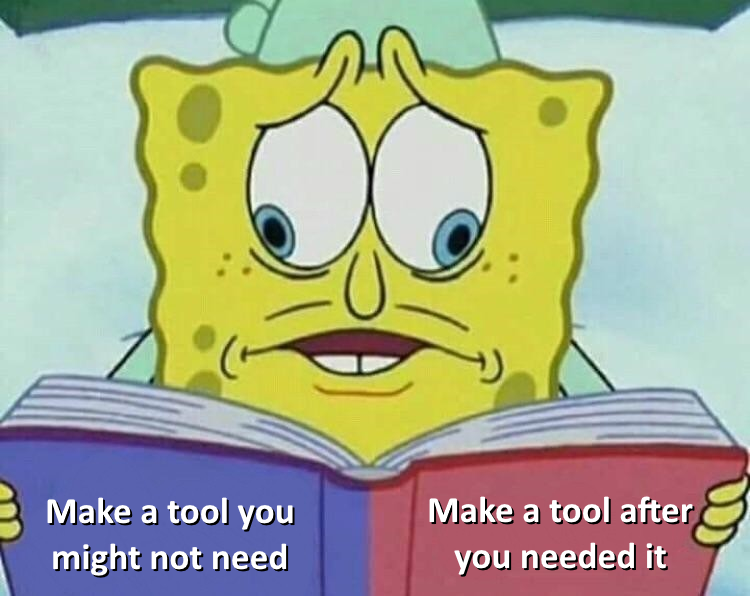
To expand on this last point: Never, ever make a feature or tool because you think you might need it later. Did you know, for example, that NPCs in Between Horizons can not only call, but use elevators? And that they can enter them together, stepping out of each other’s way, and exit them at different stops, all integrated with our pathfinding system? If you’ve played the game, you may be correctly remembering right now that NOT A SINGLE NPC EVER EVEN USES AN ELEVATOR. This was another moronic waste of resources on my part that I stopped way too late.
Part 4: Everything else that went wrong
So far, I’ve been focussing on strategic failures that hindered the production process. While they did make it harder to break even by increasing the project’s development time and budget, they didn’t necessarily set it up for commercial failure. Some competitors in the detective genre, including our own first game, have proven the niche to be way bigger than the audience Between Horizons is reaching. So why aren’t they buying it?
The product
Regardless of your personal opinion on some mainstream titles, we can all agree that a terrible game will never sell well. But a terrible game does not score 91% on Steam and 83 on Metacritic. A masterpiece would’ve certainly sold better, but Between Horizons’ main issue isn’t quality – it’s marketability. Unlike the marketing itself, which fell on our publisher, this aspect was in our hands alone, and we failed big time in my opinion.
When you’re coming up with a game idea and subsequently go about its realization, you should keep marketability in mind at all times. By this I do not mean “include a completely unnecessary cute character so you can sell plushies to children later”. I mean “create a product that will be able to immediately communicate the experience players will get”. Our first title Lacuna had an on-the-nose noir setting with a brooding, smoking, trenchcoat-wearing main character that we plastered all over the game’s key artworks and trailers. Mood, setting, and protagonist being recognizably taken from detective stories created an expectation that there might be detective gameplay. We did mess up the title – because what does “Lacuna” even mean? –, so we added the subtitle “A Sci-Fi Noir Adventure”. Games that did a way better job on this include “Case Of The Golden Idol” (there’s a case, so you’re a detective) and, maybe the best example, “Duck Detective” (you’re a duck who is a detective, duh).
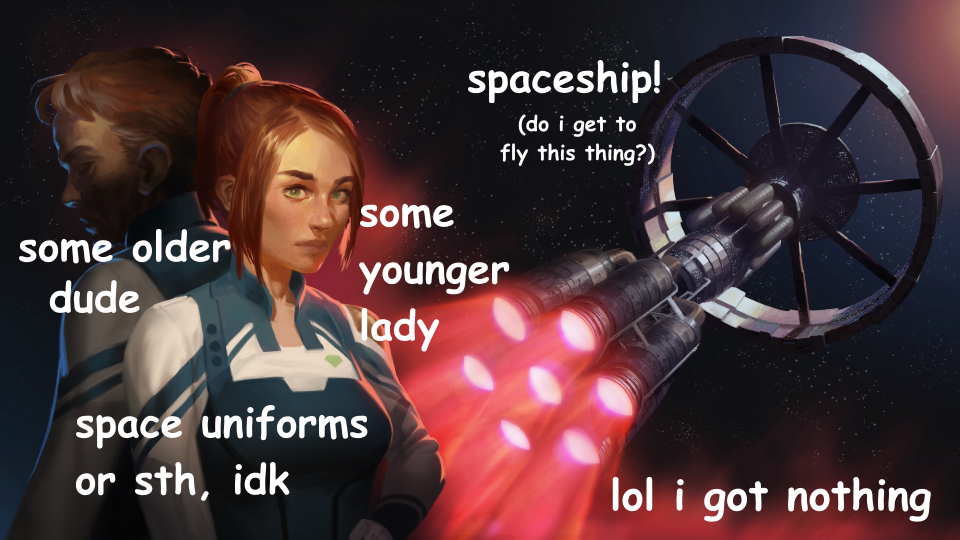
I used to think that all those long isekai manga titles were silly, now I think they’re brilliant. It’s true that nobody reads past the title anymore, so you might as well put the whole premise in it. Maybe it’s just a matter of time until games like “Help! My girlfriend turned into a fridge, and now we have to battle through a grocery store dungeon together” start blazing a trail on storefronts across all platforms. Half-jokes aside, “Between Horizons” is a similarly awful title to our first. At least it vaguely suggests sci-fi – but then we made the crucial mistake of commissioning a redundant key artwork that does the same. Here’s how I imagine people saw the artwork for the first time:
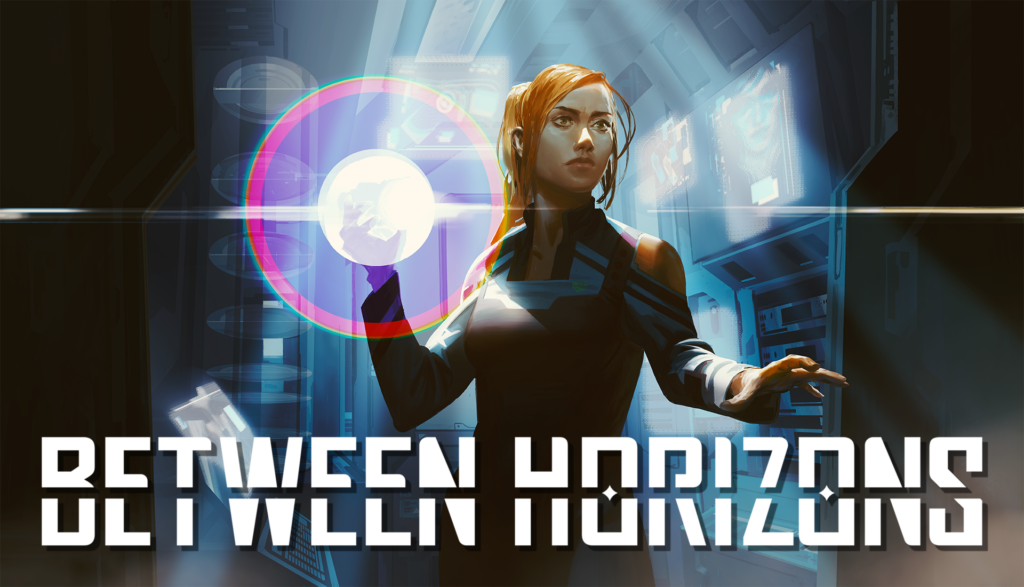
Nothing about the title, the artwork, the art style, even the setting hints at the most important thing: the gameplay. This is why we decided to change the key artwork to something more mysterious and add the subtitle “A Sci-Fi Detective Adventure” over a year after release. We bundled it with a mid-sized update to the game addressing countless small issues that players had reported, and it was very well-received by the community. Unfortunately, it’s incredibly hard to catch a second wind once the Steam algorithm has made up its mind about your game. At least it’s not completely dead in the water, steadily gaining about 5 reviews every week. The impact of the rebrand is impossible for me to determine, but I like to think it helps prop up the long tail at least a little.
The marketing
So we agree that a terrible game can’t sell like gangbusters, but the more interesting question is: Can an amazing game sell terribly? I would certainly sleep better at night knowing that we made a perfect product, and our publisher simply failed to market it.
Nothing works anymore
While I do think the marketing for our game was stingy and lackluster, this seems to be the norm nowadays across publishers, studios, and PR agencies. Even the better efforts are constantly failing, especially lately. I recently had a chat with a friend whose latest indie production failed to gain traction and sold miserably on release. This is despite the game looking polished as hell, being a few million euros heavy, and the studio having thrown thousands of euros per month (!) at an established PR agency. Their coveted advice included industry secrets such as “maybe make another Instagram post” or “try sending out a newsletter”. When nothing seemed to work and wishlists remained far south of 10.000, my friend confronted the PR agency, who admitted that none of their current campaigns were working at all. This was a few months ago, just one of countless recent indie releases with high production value that completely and utterly bombed.
For You can work against you
So why is it so hard nowadays to build an audience to sell your game to? Before we turn to the overcrowded market and the post-COVID bust, I would like to point the finger at social media platforms. They used to be places where you could get the word out to your followers. Unfortunately, followers mean next to nothing nowadays. Chances are that they will never see your content again after they hit that follow button. After TikTok’s success with the For You page, other platforms followed suit, serving up endless content from strangers across the globe that is algorithmically optimized to keep you on their platform for as long as possible.
For example, my girlfriend has over 270.000 TikTok followers. Her least successful videos sit at just 25.000 views (meaning less than 10% of her followers ever got to see them), while the most viewed one has 11.5 million (meaning her followers contributed at most around 2% to its success). You could say that this is great – you may not be able to cultivate fans as easily, but your content has an easier time than ever before reaching new people. While this is true, conversions to wishlists or sales from this type of feed are abysmal in my experience. Very few people will interrupt their scrolling session of infinite dopamine to hop on Steam. If you somehow get them to, algorithms might be quick to punish you and stop serving up your content because they notice that it drives people away from their platform. Some may bookmark the video, but most of them are merely building a separate “to-be-wishlisted” pile of shame on TikTok next to the “to-be-played” one on Steam.
All that being said, For You pages can give your game a considerable boost if you manage to have a viral moment. If the view count is massive enough, even a tiny conversion rate can make major difference. Some developers have been building their games around their viral potential, with the “friend slop” category leading the charge lately. People love watching highlights from these games because they are extremely easy to understand and digest in the span of a few seconds. (And streamers love playing them in large part because they are hoping for a viral moment of their own.) Unfortunately, Between Horizons is almost the opposite of all that. There are no explosions, silly ragdoll moments, proximity chat, or funny voice filters. It doesn’t have a very clear formula and coherent premise that is quick to get across. On top of that, it’s a wordy, slow-paced singleplayer game where the fun lies in uncovering and understanding a complex story. It builds a relationship with players much in the same way a book does: in a long, quiet session on the couch or at the desk in the privacy of their home. Creating short-form content around it is possible, but very difficult.
Luckily, there is always the route of (perceived) authenticity and relatability that’s doing quite well in this era of parasocial relationships. If your game isn’t exactly a For You page content machine, you can put yourself and the people from your studio in the spotlight. This is not for everyone, and – to me – often comes across as pandering and fake. Some devs go as far as completely making up their own human-interest story. It genuinely pisses me off to see posts hit the front page of Reddit claiming “I quit my job to make this passion project all on my own” when I know the game to be the fifth project of an established 12-person studio. And no, I am not jealous, as we can all play at that game if we want to – I simply dislike lying and liars, and I’ve always wanted Between Horizons to stand on its own rather than generating interest through clickbaity sob stories.
On a side note, games like ours also do horribly at live events due to their slow burn approach. Almost nobody takes an hour out of their gamescom schedule to immerse themselves into a story while their friends are waiting to move on, and the neighboring booth blasts loud music in their right ear. At best, people might take a business card and check it out online once they get home. Be very hesitant to drop money on physical events if you’re making games like ours, and consider how much more (and better-suited) coverage it could get you online. Events can worth be your while if you can also score some in-person business meetings and/or if they give you access to a featured Steam sale. If you do end up at an event, and your game does poorly (or very well), the only thing you can safely take away from that is that it’s a very bad (or very good) game for live events. In my experience, this is not at all reflective of its long-term performance on the storefronts.
The industry
It’s convenient to blame the state of the industry, and there is some truth to it. Luckily, in 2021, publishers were still much more willing to sign investment deals, and the German state funding program hadn’t run out of money yet. We managed to secure both for Between Horizons right as these doors started closing slowly.
That being said, the game’s release in 2024 still fell victim to the ensuing bust in multiple ways. In case you’re not aware, the COVID pandemic lead to a growth boom in the industry, as people were stuck at home playing games. Lacuna came out in May of 2021, and there is no doubt in my mind that the pandemic was a major contributor to its success. Throughout the pandemic, publishers and investors were riding the wave and throwing money around to fund a plethora of new projects. Fast forward a few years – the lockdowns are over, people are touching grass again, and the immense volume of games funded during the boom begins flooding the market. One of them is Between Horizons. There is of course no way to peek into an alternate reality where the games traded release windows, but it’s conceivable that our 2021 release would have always outperformed our 2024 release.
When you are in an industry, you are always at the mercy of major forces (politics, economics, trends etc.) outside your control. You can do virtually everything right and still lose. This has always been true, but the past few years have made it painfully clear as most (!) of our friends’ studios threw in the towel. These were established companies with multiple successful titles on the market who continued to produce highly polished games with considerable budgets until the very end. In Germany alone, Mimimi Games, Studio Fizbin, Maschinen-Mensch, gentlymad, and countless others – some of which just haven’t publicized it yet – called it quits just over the past two years. The fact that we’re still standing (without having been bought up) almost makes us an outlier.
Go big or go small
I laid out earlier how growing for its own sake was a mistake, and I want to take this thought one step further. Are you ready for my hot take? I believe that mid-sized indie teams are a dying breed.
On one end of the spectrum, teams of 1-5 people on a shoestring budget don’t need much to be sustainable, and even a moderately successful title stands a decent chance of making its money back and then some. Little overhead and shorter development cycles keep things dynamic and efficient. On a small budget, more ideas can be attempted, and they can be bolder. In fact, a good chunk of breakout indie hits in recent memory were created by such teams.
I sometimes believe that the term “niche” is misused by people who refer to a strange or unusual concept that they believe will only reach a few existing hardcore fans. However, there was no “shotgun Russian roulette” fandom waiting patiently for Buckshot Roulette to come out, and the massive audience the game ended up reaching cannot be reasonable described as a niche. Yet, the game is deeply weird and extremely focussed around the “niche” thing that it does. The same goes for Blue Prince, Balatro, Mouthwashing, and many other breakout hits that simply dared to do something that, in my opinion, is only possible with a smaller, determined team on a modest budget. On the other end of the spectrum, there are AA teams upwards of 30 people that can produce polished projects with a wide market appeal and the ability to ship live service content, making the double-digit millions of investment (sometimes) worth it.
This leaves the middle. Teams that are too big to follow the weird and bold “auteur” ideas, with budgets too high to justify such risks anyway. They often end up with relatively costly, design-by-committee titles that try to appeal to everyone while doing nothing in particular better than any other game. Too boring to stand out, and too small and unpolished to reach a truly big audience, they stand no chance of ever making their bloated budgets back. Many of these mid-sized studios have been closing down or scaling down, and I believe that this trend is here to stay for a long time. To relate this back to Between Horizons, I’m trying to say it might not have been too “niche” – but in fact not “niche” enough.
Part 5: Acceptance
If you’ve made it through all this yapping, you deserve a summary of key takeaways. If you scrolled straight down here: Hi, hello, how does it feel to be a dirty cheater? I’m just kidding, I forgive you.
I’ve grouped these by topic rather than following the train of thought above:
Which game to make (next)
If you’ve made a successful game and want to stay in its niche, iterate carefully and with purpose. Try new ideas with players as early as possible, especially ones that require expanding the scope and upping the budget.
Making a sequel is risky because people might, at best, just buy the first game more and never get around to the second.
From the inception to the execution of your game idea, keep marketability (and maybe viral potential) in mind. Genre, art style, characters, game title, and gameplay need to be a coherent package that immediately communicates the experience in unison.
Consider mocking up many game ideas quickly and cheaply, get them in front of an audience, and see what sticks.
Production and company pitfalls
These are the most personal and subjective takeaways, specifically for allrounders who could do most or all of it by themselves:
Be careful about growing your studio. You might burden yourself with overhead, lose ownership and creative control, and bloat the budget just so less experienced people get to do the fun part.
Give up control of technical aspects at your own peril. Depending on someone with a normal, non-24/7 schedule to constantly fix things for you will slow you down – and once they are gone, good luck creating updates for the game.
Never create systems, tools, or assets purely based on the assumption that you might need them later.
The player experience is key, clean code is not. If a quick and hacky solution does the thing you need, it is the best solution. More elaborate systems don’t necessarily break less often, but might take longer to get back into when they do.
Market(ing) perils
Conventional knowledge doesn’t seem to work anymore, and even big players seem to have no idea what they’re doing when it comes to marketing. Be very wary of giving money to a PR agency or shares to a publisher if they don’t have a stellar track record.
The For You page has made it impossible to cultivate a recurring audience. Many new people may see your posts, but conversions are horrible. Viral moments are more achievable than ever, but only certain games lend themselves to those. If your game doesn’t, try spotlighting your studio and being relatable.
Mid-sized indie studios shutting down left and right might be more than just the post-COVID bust. The future may belong to big productions on the one end, and small, efficient studios on the other, who operate with budgets low enough to allow for bold ideas that can still reach a surprisingly large audience.
You can do just about everything right and still fail due to circumstances outside of your control.
A word of encouragement
Most of what I’ve written here might sound horribly grim to you, and I feel the need to put some of it in perspective:
First, this being a post-mortem, I’ve focussed heavily on our mistakes since those teach us the most valuable lessons. We also got a million things right before, during, and after the game’s development. I deeply appreciate and value every single person who worked on Between Horizons internally, externally, and at our publisher, even though I’ve mostly criticized them (and myself) here.
Second, even though many studios have been closing down, and countless people have been laid off, many of them aren’t leaving the industry. Some might be starting something new and incredible right now. In the same period, the market has only continued to grow – and so has the absolute (not relative) number of new releases making good money on Steam. I’ve tried to lay out a few ways to come up with games that might do well, but I’m sure that there are 1000 more waiting to be discovered (by you!).
And finally: We’re just making video games. We didn’t crash a plane or mess up a brain surgery. You live and you learn, or in this case I did the living and hope that both you and I learned something from it. Once we’ve salvaged the past for mistakes to avoid in the future, we can shift our attention forward and think about our next venture that might just turn out better in every way. If it doesn’t, rinse and repeat. After all, you only truly lose the game once you decide to stop playing.
This is Julian from DigiTales. I haven’t written a proper blog post in almost a year even though a lot was going on behind the scenes. In a nutshell, we were having a tough time like many of our fellow indies. I’m not going to get into the various crises, detours, and tough decisions of the past year because the bottom line is: We made it out the other end, and we’re feeling better than we have in a long time.
DigiTales Publishing?
That’s right, we’re doing the thing! You either die a dev, or live long enough to become a publisher. In our case, this was a spur-of-the-moment decision when we saw the opportunity to help our friends at Forking Paths Gardening Interactive get their first game across the finish line. It’s called The Great Sassanelli, and I’ll tell you more about it below!
DigiTales x Forking Paths
Quick Q&A
Q: Wait, are you no longer making games in-house? A: On the contrary! We are currently working on one and have the next one already lined up.
Q: Do you take new pitches? A: Not right now, as our attention is fully taken up by Sassanelli and our own new in-house title. We don’t even know if we’ll ever publish other titles, or if the experiment starts and ends here.
Q: What do you do as a publisher? A: Marketing, PR, and distribution. For Sassanelli, we also took over producing and programming to help finish the game.
Q: Can you even do these things? A: We’ll see! With many years of combined second- and first-hand experience surrounding the publishing process, we feel ready to take on the challenge.
Q: Does all this mean you’re going to self-publish from now on? A: Not necessarily. For our current in-house title, we are actually looking to work with a larger publisher, although self-publishing is an attractive option as well.
Q: Those are stupid questions, can I ask you other ones? A: Yes, please email us: publishing[at]digitales.games
The Great Sassanelli
We’ve actually been following this project for many years, ever since it was just an idea in Forking Paths co-founder Nico’s head. It slowly developed into an amazingly written and unique interactive novel about a travelling circus in WWI Europe. When Forking Paths were presented with a tough choice about its future (which they expertly anticipated when naming their studio), we proposed to help finish and publish the game because we just… need it to be out there. Oh, and maybe you recognize the amazing art style – Sassanelli’s sole artist Jon created both Between Horizons key artworks.
I’m not going to try to sell you on the game here, that’s what the store page is for! Please, please wishlist the game now on Steam if it sounds like your jam, so Forking Paths think we’re doing an excellent job as a publisher. It’s not coming out until next year, but you can follow its development on our channels. We’re about to post interviews, feature spotlights, character intros and more that should give you an idea of why we fell in love with it.
Status Quo
With the headline announcement out of the way, let’s catch you up on the past year and take a brief look at the present and future!
ICYMI
Here’s a quick-fire round of what we’ve been up to since the Between Horizons console release a year ago:
6VCR Shop: World-renowned pixel artist 6VCR joined our team three years ago, and in January of this year, we collaborated on the relaunch of her shop featuring her amazing artworks in various physical and digital forms.
Unburied Kickstarter: For the past two years, we’ve already known which game we’re going to make after the current one: a psychological survival horror title called Unburied. We have some great plans for it and will update the Kickstarter preview page later this year with lots more details. Follow it now to stay in the loop!
Between Horizons 1.2.0: This major patch came out on PC in June, introducing a host of fixes, upgrades, and QoL improvements, alongside a new kick-ass key artwork. Full patch notes here. We have another update planned, but no concrete timeline yet.
Sticky Business: We collaborated with our friends at Spellgarden Games to bring new content for their breakout hit Sticky Business to PC and Nintendo Switch: the free Pride, Among Us, and QoL updates as well as the Camp Zinnias and Book Of Shadows DLCs.
New DigiTales game
Despite its very favorable reception, Between Horizons was somewhat of a dud commercially. There are many complex reasons for it, and I’ll lay them all out in a detailed post-mortem soon. Combined with the larger industry crisis at hand, we were unfortunately forced to cut down our team by more than half, among other concessions.
While that hurt a lot, there is a silver lining: The efficiency and quality output of our reduced crew over the past few months has been mind-blowing. It gave me great confidence that we can deliver our next game at a fraction of the cost, in less time, at an even better quality than our last. The new title is already close to being feature-complete, and about a third of its contents are finished in final quality. If things continue this way, we expect it to release in 2027.
I’m not going to reveal more about the new game for now, but if you liked our previous titles, it should be right up your alley. Follow us so you don’t miss the big reveal. As mentioned above, we are looking to work with a larger publisher to get it over the finish line, so feel free hit us up if you are one! We have a pitch deck and vertical slice ready to go.
New office, old friends
We have moved yet again if you can believe it, making this our fourth office in six years. However, I don’t expect another move any time soon as this one meets our needs perfectly. We have our own space on a shared floor with some indie friends, finally reuniting with our old office roomies Radical Fish Games after over two years apart.
Our new place right after moving in (still a bit of a mess)
That’s the long and… not-so-short of it. Please wishlist The Great Sassanelli, and follow our socials for more regular updates.
Thank you so much for reading and, as always, for all the love and support over the years.
Half a year after its PC release, Between Horizons is now finally available on all consoles. As of today, you can find it on the Nintendo eShop (launch discount!), the Microsoft Store, and the PlayStation Store.
This marks the first time a DigiTales title was ported completely in-house. We hope you enjoy the game as much as our PC players do, as the game is currently sitting at 92% positive reviews on Steam.
We are proud of our work, but also deeply exhausted after this lengthy and arduous production phase. Our next project is still a ways away, so be sure to follow us if you don’t want to miss the announcement.
Between Horizons was released on PC (Steam and GOG) on March 25, 2024! The free demo is now also available on both platforms. Console ports are already in the works and will be coming later this year.
It took us a while to finally get this post out as we’ve been busy with the release and some patches. Just in the first week, the game received close to 100 Steam reviews totaling a Very Positive (91%) rating.
Thank you all so much for your feedback, both positive and critical, and all the support over the past three years! We really hope you enjoy your journey on the Zephyr. Please share your thoughts our our Discord server, or the Steam forums. Last but not least, please leave a review if you enjoy the game! It’s the single biggest thing you can do to support us (or any indie studio).
Let’s keep this one short and sweet: It’s finally time to mark your calendars!
Three years in the making, Between Horizons is coming out on PC March 25, 2024! 🍾 We hope you enjoy the new trailer, and we can’t wait for you to check out the full game.
You may have noticed that we haven’t shared much about ourselves or our work on Between Horizons over the last year or so. Time to bring you up to speed!
🎮 New demo at gamescom 🎮
In spring of this year, we released a demo of our upcoming sci-fi detective adventure Between Horizons. Despite its favorable reception, we pulled it again about three months later for a number of reasons. Today, we are excited to announce that a completely revamped demo is coming to gamescom! You can find it in two places in Hall 10.2: the Indie Arena Booth as well as the GameUp!/saaris booth (E020g – D021g). Come check it out!
(Don’t fret if you can’t make it, the new demo is coming to Steam a little later.)
🩸 Unburied Kickstarter 🩸
We recently announced our plan to join forces with legendary pixel artist 6VCRto delve into the genre of survival horror together. We are extremely excited about this project, but it has no clear timeline right now as it massively depends on the response to the upcoming crowdfunding campaign. If you want to see it come to life, please follow the campaign or sign up for a one-time e-mail and help us spread the word!
🎧 Lacuna Lo-Fi 🎧
To celebrate Lacuna’s second anniversary, we released a free mini album titled Lacuna Lo-Fi, a chill remix of select tracks from the Lacuna soundtrack. You can find it on Steam, YouTube, and most streaming platforms!
🎻 Lacuna in concert 🎻
Earlier this summer, a medley of the Lacuna soundtrack was featured in a video game soundtrack concert at Saarländisches Staatstheater. From the bottom of our hearts: Thank you so much, Saarländisches Staatsorchester, Yannick Süß from HippoScore, and everybody else who helped make this possible! A full recording of the concert will air September 27 on Saarländischer Rundfunk. Check our Twitter or Instagram for a tiny sneak peek!
DigiTales co-founders Julian and Jasmin on stage with the orchestra
🏢 New office 🏢
Believe it or not, we recently moved for the fourth time in less than four years. We swear this is the last time for a while now, as the new location is everything we could ask for. It’s a very central place in Saarbrücken and just two floors underneath some good indie friends that moved in with us. Check out our break room!
❓ The future ❓
These are the major developments of the past few months that we can speak on for now. We still don’t know when exactly Between Horizons will be released, but we continue to aim for late 2023.
As for our plans beyond that, we currently have multiple projects lined up that may (or may not) be realized sequentially or concurrently starting this winter. We had more concrete plans already, but the federal games funding program being cut over night threw a massive wrench in the works.
We look forward to meeting everyone at gamescom. If you can’t make it there, stay tuned for the demo release on Steam this fall!
Best, The DigiTales team
PS: If you don’t want to constantly refresh our website to stay in the loop, how about you follow us in one of these places and/or subscribe to our newsletter!